Pace Groups Are the New Singles Mixers and the Lanyard Costs $180
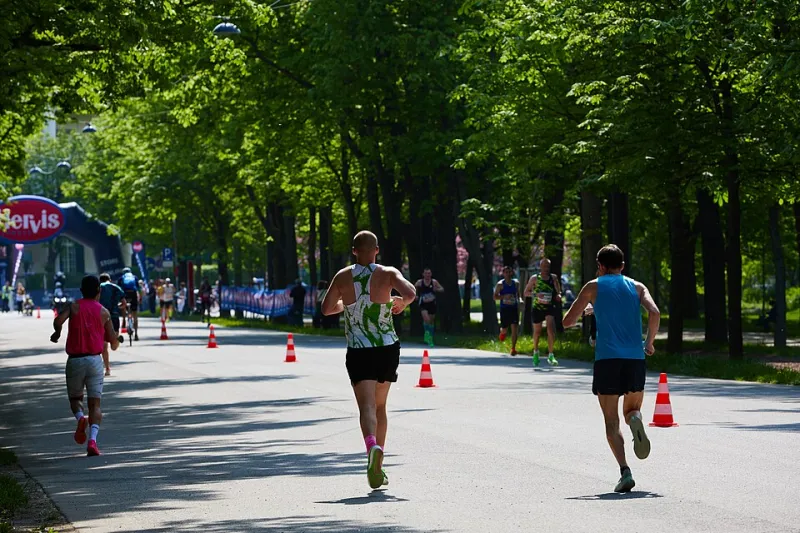
Photo: René Pudschedl, CC BY-SA 4.0, via Wikimedia Commons
It is 7:04 on a Saturday morning and forty people in matching neon are standing in a parking lot doing the specific laugh people do when they're trying to figure out where they rank. There's a guy in a singlet doing calf raises with the intensity of a man preparing for something larger than a 5K. There's a woman holding two coffees, one of which is a prop. There is a photographer—a photographer, at 7 a.m.—telling everyone to squeeze in.
This is, depending on who you ask, a fitness community, a mental health intervention, a networking event, or the most aggressively healthy way anyone has ever devised to figure out if someone is single.
The third place, but make it athletic
Bars got expensive. Churches stopped being the default. Bowling alleys were demolished for condos with a dog-washing station. The office, that great accidental social club, now opens two days a week and empties at 6. Enter the run club: weatherproof, repeatable, wholesome enough to tell your mom about, and structured enough that you never have to send the text "does anyone want to hang out" into a group chat that responds with three heart emojis and nothing else.
It solves a real problem. Millennials are lonely in a way that's been measured to death, and the run club offers the two things loneliness hates most: a fixed schedule and a face-to-face obligation. You show up because people will notice if you don't. That's not a small thing. That's basically a friendship.
The social hierarchy of pace groups
Here's where it gets interesting. Pace groups are a caste system with a stopwatch. The 7:30-mile group is the varsity table—they're friendly, they're fit, they do not slow down, and they regard the 9:00 group with the warmth of a cool older cousin who has already left for college.
The 9:00 to 10:00 group is the actual party. It's chatty, it's chaotic, and it's where roughly eighty percent of the flirting happens, because the pace permits full sentences.
The run/walk group is the freshman cafeteria: deeply welcoming, occasionally condescended to, and secretly the happiest people there, because they are not pretending that 6:45 a.m. is fun.
And then there's the couple who met at the club in 2024, got engaged on a finish line, and now lead the 11-minute group like resident advisors who are also married. They know everything. They see everything. They are the FBI of the 5K.
The etiquette of the coffee date
The run ends. The real event begins: the coffee, which is technically a cooldown and functionally a date. The rules are unwritten and rigid.
You do not ask someone out mid-run. That's a violation—you're both sweaty and one of you is a hostage on mile four. You ask at coffee, casually, in a way that can be retracted. If a group splinters into a smaller group of four, that's the move: the smaller the table, the more permission you have.
Paying is a minefield. Someone will try to pay for the whole table to establish dominance. Someone else will Venmo-request four dollars with a note that says "you too!!" and immediately ruin the romance. The healthiest people I know split the check and let it go.
And then there's the migration: from the public group chat to a spin-off chat to a DM. This is the run-club version of moving in. If you are removed from the spin-off chat, you did something. Nobody will tell you what.
"I'm training for a half" is a load-bearing lie
It's the most socially acceptable sentence in America right now. It means nothing and it means everything. It gives you a reason to be up at dawn, a reason to be in the group photo, a reason to be at the coffee shop, a reason to be somewhere that isn't your apartment, and a plausible deniability that no one is ever going to audit.
Because here's what "training for a half" actually translates to in 2026: I am looking, I am hoping to meet someone, and I would rather die than say that out loud at a bar in front of people who might know my ex.
What the $180 actually buys
Which brings us, inevitably, to the money. Run clubs started free and are being monetized with terrifying speed. There's the membership fee. There's the branded kit, the second branded kit, the "technical" T-shirt you'll wear exactly twice. There's the race entry, the team photos, the subscriber-only training plan, the app, the sponsored recovery smoothie.
You are being sold belonging. It works because belonging is expensive to produce and impossible to buy—except here, apparently, for $180 a year, plus tax.
Go. Run. Meet people. Fall in love at mile two and pretend you're just keeping someone company. Just know that the wellness language is a wrapper, and underneath the wrapper is exactly what every third place has always been: a room full of humans trying to find someone to stand next to. The run club just found a way to charge admission and call it self-care.