The Friendship Spreadsheet: Why Maintaining Your Social Life Now Feels Like a Part-Time Job You Didn't Apply For
There is a group chat on your phone right now that hasn't been active in three weeks. Before that, it had a burst of activity around someone's birthday or a meme that landed, and then it went quiet again. Nobody officially ended it. Nobody will. It just sits there, a 2019 artifact of when you all thought you'd hang out more, occasionally resurfacing to remind you that you have more friends in theory than in practice.
And yet — you're not friendless. You're actually talking to people constantly. Just never all of them, never in the same place, and never in a way that quite scratches the itch.
This is the central paradox of digital friendship in 2025: we have never had more tools for staying connected, and a genuinely alarming number of us feel more isolated than ever. The group chat isn't dead. It just fragmented into six separate DMs and a voice note you still haven't listened to.
The Silo Effect No One Warned You About
Here's how it happened, roughly.
At some point, the group chat became a performance space. Not intentionally, not maliciously — but the presence of eleven people creates an audience dynamic, and audiences change behavior. You self-edit. You post the version of the story that lands well in a group, not the version that's actually true. The funny take, not the vulnerable one. The update that makes your life look like it's on track, not the 1 AM spiral you actually need to talk through.
So you took that stuff somewhere else. To the one friend who gets it. To the DM thread that doesn't require a performance. And then that became its own little world, and the group chat became increasingly ceremonial — a place for logistics, memes, and birthday acknowledgments.
Multiply this across every social platform you're on, every friend group from every era of your life, every context in which you present a slightly different version of yourself, and you get what sociologists are starting to call context collapse management: the exhausting, full-time project of maintaining multiple coherent identities across multiple audiences simultaneously.
You are not having a social life. You are running a personal PR operation.
Algorithms Don't Care About Your Friendships
The platforms are not neutral infrastructure here. They have a vested interest in certain kinds of engagement, and genuine, low-key friendship maintenance is not particularly interesting to an algorithm.
Instagram rewards content. Twitter/X rewards takes. TikTok rewards performance. None of these platforms are optimized for the specific kind of low-stakes, low-effort ambient presence that used to be the connective tissue of friendship — the kind where you just knew what was going on in someone's life because you saw them regularly, or because the social infrastructure around you kept you in contact.
What the platforms are good at is creating the feeling of connection without the substance of it. Watching someone's stories every day gives you a detailed, curated portrait of their life that can feel intimate while actually being highly edited. You know they went to Trader Joe's and tried a new pasta. You don't know that they've been crying in their car twice a week. The illusion of closeness is so convincing that you can go months without actually talking to someone and still feel like you're in each other's lives.
And then you run into them in real life and realize you have absolutely nothing to say, because you've been watching each other's highlight reels and mistaking that for a relationship.
The Maintenance Tax
Real friendship, it turns out, requires effort that doesn't scale.
This sounds obvious when you say it out loud, but it runs directly counter to the logic of every platform we use, which is fundamentally about efficiency and reach. Social media lets you maintain the appearance of a large, active social network with relatively low effort. Which is great for your follower count and deeply inadequate for your actual wellbeing.
Actual research on loneliness — including the decade-long Harvard Study of Adult Development, which is basically the Rosetta Stone of human connection science — consistently shows that the quality and depth of relationships matters enormously for mental and physical health, while the quantity and frequency of low-depth interactions does very little. You can like a hundred posts today and feel profoundly alone tonight. The data supports this.
What the research also shows is that closeness is built through shared experience, reciprocal vulnerability, and time — none of which are particularly compatible with a DM thread you check between meetings.
The friendships that survive and deepen are the ones where someone decided to do the inefficient thing. The phone call instead of the text. The actual visit instead of the "we should hang soon" that both parties know is not a plan. The conversation that goes somewhere real instead of staying safely in the zone of mutual content appreciation.
This stuff takes time and energy that, genuinely, a lot of us don't feel like we have. The irony is that spending that energy is exactly what would make us feel less depleted overall. But the activation energy required to go from DM-based pseudo-friendship to actual human contact has somehow become enormous, and the platforms are not helping reduce it.
The Version of You That Only Exists in One DM Thread
There's also something worth examining about the identity fragmentation piece specifically — because it's not just lonely, it's genuinely disorienting.
When you're maintaining multiple versions of yourself for multiple audiences, there's a slow erosion of a coherent sense of self. The you that exists in your work friends' group chat is not the same as the you in the college friends thread, which is not the same as the you your family sees, which is not the same as your TikTok persona if you have one. Each of these selves is real and also partial. None of them are the whole picture.
Psychologists call this self-concept fragmentation, and while some degree of context-appropriate code-switching is healthy and normal, the scale at which digital life requires it is new. Previous generations had fewer audiences to manage. The self had fewer performance obligations. There was, arguably, more room to just be a person.
Figuring out who you actually are when no one is watching has become harder when someone is always, technically, watching.
Nobody Is Asking You to Quit the Internet
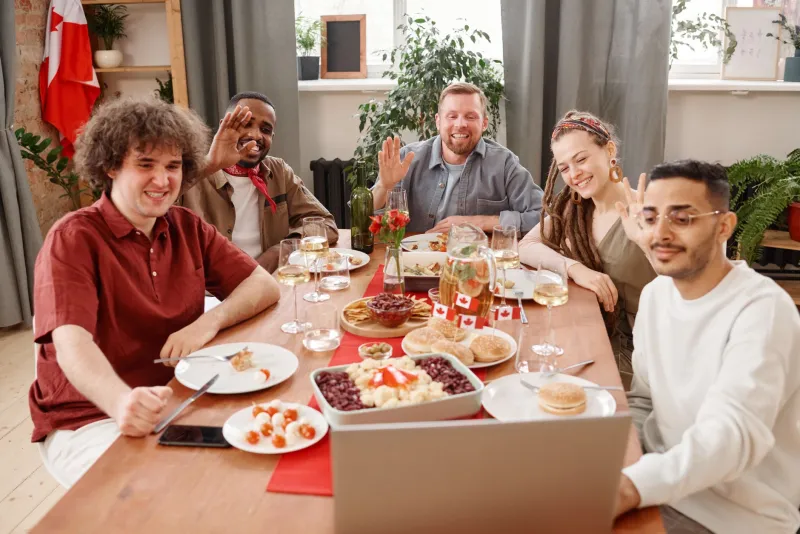
This is not a manifesto for deleting everything and hosting a dinner party (though the dinner party, honestly, remains underrated — someone bring wine, someone bring a dish that requires a story about where the recipe came from, and watch what happens to the conversation).
The point is smaller and more practical: notice when the maintenance of your social presence is substituting for the substance of your social life. Notice when you know what someone had for breakfast but couldn't tell someone else what that person is actually going through right now.
Pick one person this week. Not a like, not a story reply. An actual message that says something real. Or a call, if you're feeling feral about it.
The group chat will survive without you for a few hours.